

ADAS Calibration in Houston, Done In-House, to OEM Spec
ADAS calibration in Houston is the process of precisely re-aiming the cameras, radar, and sensors that power your vehicle's driver-assistance systems after a collision, windshield replacement, or suspension repair.
At Texas Auto Center, we do it in-house on Bellaire Blvd, to manufacturer specification, before your car leaves our lot. Your 2018-or-newer vehicle probably has more computer vision hardware than your laptop — and it all depends on precise alignment to work correctly.
Key Takeaways
- Calibration comes in two types: static(performed in the shop with factory targets) and dynamic(performed on a road test). Many vehicles require both.
- Typical Houston cost ranges: $150–$300 for a single-system calibration, $300–$600 for multi-system work, and $600–$1,000+ for complex luxury or EV systems.
- Insurance usually covers calibration when it's part of a covered collision or windshield claim. We write the supplement when the initial estimate leaves it off.
- Texas Auto Center performs both static and dynamic calibration in-house using OEM procedures, factory targets, and pre- and post-repair diagnostic scans. Every job gets documented.
What Is ADAS Calibration?
ADAS stands for Advanced Driver Assistance Systems. It's the umbrella term for the cameras, radar modules, lidar units, and ultrasonic sensors that feed data to your vehicle's safety software. The most common systems include:
Forward Collision Warning (FCW)
Alerts you when a collision is imminent and can trigger automatic emergency braking.
Automatic Emergency Braking (AEB)
Applies the brakes if you don't respond in time to a forward collision alert.
Lane Keep Assist (LKA) & Lane Departure Warning (LDW)
Keeps you centered in your lane and warns when you drift without signaling.
Adaptive Cruise Control (ACC)
Maintains a set distance from the car ahead, slowing and accelerating automatically.
Blind Spot Monitoring (BSM)
Flags vehicles in adjacent lanes that fall outside your mirrors' field of view.
360-Degree Cameras & Parking Sensors
Gives you a top-down view when parking and detects nearby obstacles ultrasonically.
Calibration is the process of aligning these sensors so they match the vehicle's reference axis and the manufacturer's factory configuration. When a camera is mounted a few millimeters out of spec, or a radar sensor is angled a fraction of a degree off, the entire system's understanding of the road shifts. According to I-CAR's repairability technical support guidelines, any vehicle equipped with ADAS that has been in a collision will almost certainly require calibration, regardless of impact severity.
When Does Your Vehicle Need ADAS Calibration?
Here's what most Houston body shops won't tell you: after any collision that touches a bumper, windshield, grille, or panel with a sensor behind it, those systems don't just bolt back on and work. They have to be recalibrated. Not reset — recalibrated to OEM specification using factory targets and OEM scan tools.
After Any Collision
Even a low-speed fender bender can shift sensor positioning enough to compromise ADAS accuracy. A 4mm misalignment of a windshield-mounted forward camera can throw the system's aim off by several degrees at highway distance.
After Windshield Replacement
Windshield replacement is the number-one trigger for ADAS recalibration. Most modern vehicles mount the forward-facing camera directly to the glass or the housing behind it. A new windshield almost always means a new calibration, even when the replacement looks perfectly aligned. Read our full guide on ADAS calibration after windshield replacement →
After Wheel Alignment or Suspension Work
Suspension geometry changes how the vehicle sits relative to the road. Some radar and camera systems reference the vehicle's thrust angle as part of their calibration baseline.
If You See Symptoms
Your car will usually tell you when something is off:
- Lane-keep assist drifting toward one side or not engaging at all
- Adaptive cruise braking late, braking unexpectedly, or refusing to set
- Blind-spot monitor that misses vehicles or stays lit constantly
- Warning lights referencing ADAS, camera, or sensor faults
- Forward collision warning triggering false alarms or silent on real threats
If your ADAS is acting strange after a repair, call (713) 667-1100 and we’ll do a free diagnostic check.
Static vs. Dynamic ADAS Calibration
Calibration is not one procedure. There are two main types, and many vehicles require both in sequence.
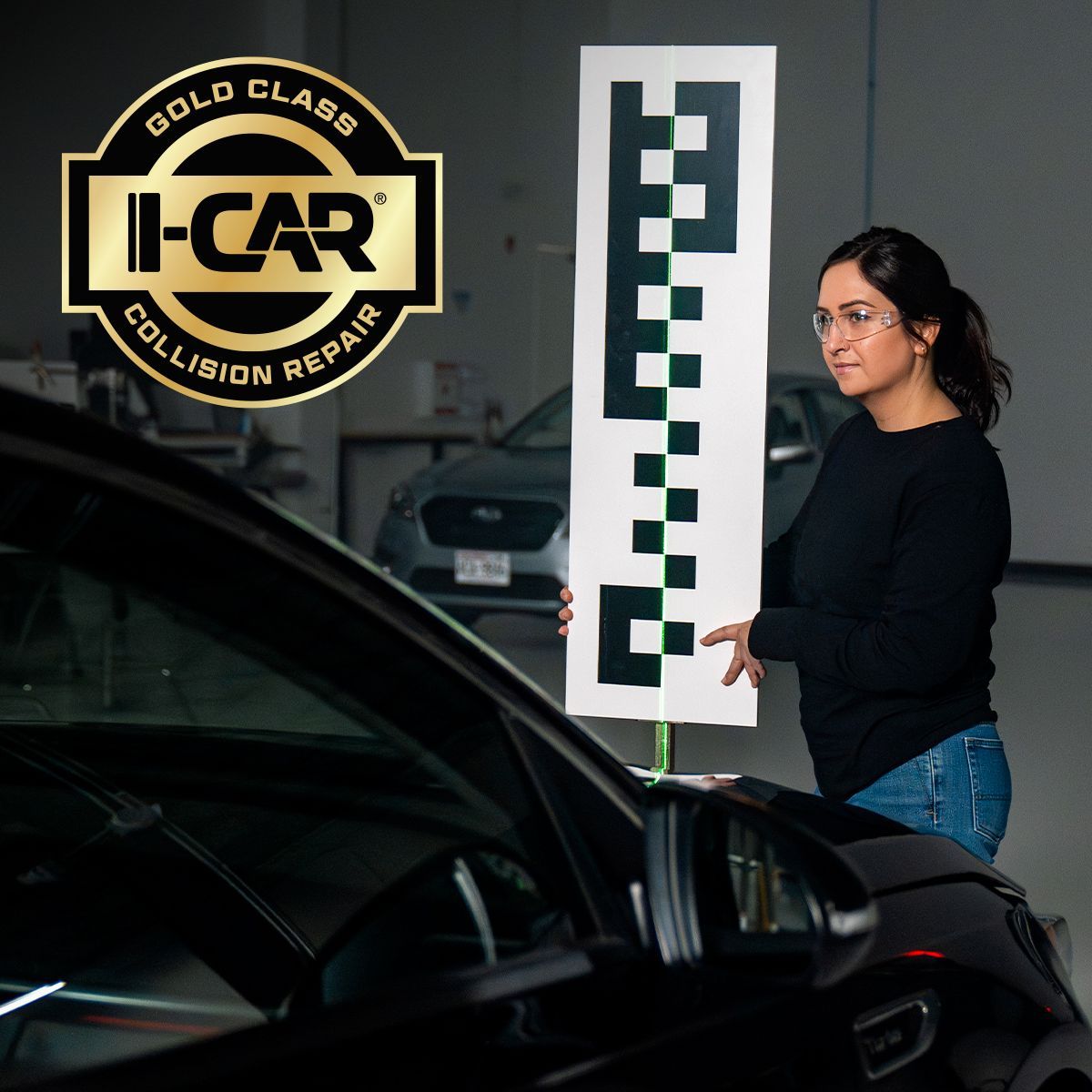
Static calibration happens in the shop. The technician positions factory-supplied target boards, patterns, or reflectors at precise distances and angles from the vehicle, then connects diagnostic software to the car’s computer. The software walks through a calibration routine, verifying that each sensor sees the targets exactly where it should. Static calibration demands a level floor, controlled lighting, minimum working space, and the exact OEM targets for that make and model.
Dynamic calibration happens on the road. The technician drives the vehicle under specific conditions — a certain speed, lane markings visible, traffic ahead at a set distance — while the software observes the ADAS sensors self-calibrating against real-world data. Adaptive cruise systems, some lane-keep modules, and newer multi-sensor fusion systems often require a dynamic pass.
Many 2020-and-newer vehicles require a static calibration first (to set the sensor baseline) followed by a dynamic calibration (to fine-tune against actual driving data). Skipping one or doing them out of order leaves the system in an unreliable state.
Real scenario: Maria, a Sharpstown driver, brought her 2022 Hyundai Tucson in after a minor rear-end collision near the 610 feeder. The other driver’s insurance had approved an estimate that included a new rear bumper, blind-spot sensor, and paint. What it didn’t include: a dynamic recalibration of the rear radar system. Without it, her blind-spot monitor was missing cars in the next lane. We wrote the supplement, calibrated the system to OEM spec, and documented every step. Maria paid nothing extra. The carrier covered it because the repair genuinely required it.
That’s the kind of oversight we catch. See our full collision repair process →
How ADAS Calibration Works at Texas Auto Center
We treat calibration as a required step of any qualifying repair, not a line-item add-on. Here's what happens.
Before we touch any body panel, we plug into the OBD-II port and run a full system scan. This captures every stored fault code and identifies which ADAS modules are affected before repair begins. The scan is documented and goes into your repair file.
We complete all structural, panel, paint, and mechanical repairs according to the OEM repair procedure for your specific make, model, and year before calibration begins.
We set up the factory targets in our calibration bay and run the OEM software routine, verifying each system one at a time — forward cameras, radar, and windshield-mounted sensors.
For systems that require a road test, we run the prescribed dynamic calibration route at the OEM-specified speeds and conditions. This usually takes 15–30 minutes depending on the systems involved.
After calibration, we run a second full diagnostic scan to verify every module is reporting healthy, every sensor is online, and no stored fault codes remain. Pre- and post-scan reports go into your repair documentation and to the insurance carrier with our invoice.
Total time in the shop: usually 1–3 hours for the calibration itself, on top of the repair time.
How Much Does ADAS Calibration Cost in Houston?
| Calibration Type | Typical Cost Range |
|---|---|
| Single system (e.g., windshield camera) | $150–$300 |
| Multi-system (two or three modules) | $300–$600 |
| Complex luxury or EV systems | $600–$1,000+ |
A single forward-camera calibration after a windshield replacement sits at the low end. A 2022 Genesis GV80 that needs a static front radar, a dynamic ACC, and a static 360-camera routine will sit higher. The price depends on the make, model, year, number of systems, whether static or dynamic, and the OEM equipment and targets required.
If insurance is covering the underlying repair, calibration is typically covered as part of that claim. If the initial estimate doesn't include it, we write a supplement — and we do not ask you to pay the difference.
Real scenario: Maria, a Meyerland driver with a 2023 Hyundai Tucson, was hit from behind on the 610 loop. Her insurer approved an estimate for a new rear bumper, blind-spot sensor, and paint. What it didn't include: a dynamic recalibration of the rear radar system. Without it, her blind-spot monitor was missing cars in the next lane. We wrote the supplement, calibrated the system to OEM spec, and documented every step. Maria paid nothing extra. The carrier covered it because the repair genuinely required it.
That's the kind of oversight we catch. See our full collision repair process →
Real scenario: James, a Bellaire driver with a 2021 Jeep Wrangler, was rear-ended on Bissonnet. His insurer approved a $3,400 estimate for bumper and hatch work — nowhere in it was the dynamic recalibration of the rear camera and parking sensors the OEM procedure required. We wrote the supplement for $425. His carrier approved it in four business days. James paid his $500 deductible. Total out-of-pocket: $500, not $925. The system worked the way it was supposed to once somebody pushed it.
Texas law (Title 28, Section 5.501 of the Texas Administrative Code) says you pick the repair shop, not your insurance company. If an adjuster steers you toward a shop that won't do calibration, or won't write the supplement, that's your signal to call us instead. Our insurance help page goes deeper on this →
Does Insurance Cover ADAS Calibration?
In most cases, yes. If the calibration is necessary as part of an approved collision repair or windshield claim, it is covered under your collision or comprehensive coverage, minus your deductible.
Insurance adjusters don’t always include ADAS calibration line items in the initial estimate. Sometimes it’s oversight. Sometimes it’s a cost-control tactic. Either way, the calibration is still required if the repair procedure calls for it.
When we identify a necessary calibration that the adjuster left off, we write a supplement to the claim. We document the calibration requirement with photos, OEM procedure citations, and pre-scan reports, and send the supplement to your carrier for approval. You don’t pay the difference.
Want to know what calibration will cost for your specific vehicle?
- Call (713) 667-1100 or request a free estimate — we’ll give you a real number based on your year, make, and damage.
- If insurance is covering the underlying repair, calibration is typically included and you pay only your deductible.
- If calibration isn’t in the initial estimate, we write the supplement. You don’t chase the carrier — we do.
Why Have ADAS Calibration Done In-House?
Many body shops outsource calibration to a mobile calibration vendor or a dealership. That means your car leaves the shop uncalibrated, gets driven to another facility, and comes back — or the mobile unit shows up with a portable target setup that may not meet all OEM floor-flatness and lighting requirements. Here's why in-house matters:
The technicians who did the repair also run the calibration. Everything is in one file, one invoice, and one set of scan reports.
You shouldn't rely on ADAS features until calibration is complete. In-house means the car doesn't leave until the job is done.
We maintain the floor-flatness tolerances and lighting conditions that OEM static calibration procedures require.
The same technicians who did the work certify the calibration was performed. Accountability is single-source.
ADAS Calibration for Every Make and Model
We are factory-certified for the following brands and perform calibration to OEM procedure for each:
For brands outside that list — Toyota, Honda, BMW, Mercedes-Benz, Tesla, and others — we still follow the OEM repair procedure, use OEM or OEM-equivalent parts where the procedure calls for them, and calibrate to manufacturer specification. Our I-CAR and ASE certifications apply across the board.
Serving Bellaire, Gulfton, Sharpstown, Meyerland, and Southwest Houston
Texas Auto Center is at 5609 Bellaire Blvd #B, Houston, TX 77081 — right on Bellaire Blvd, minutes from the 610 Loop and 59/69 Southwest Freeway. We draw customers from Bellaire, West University, Meyerland, Gulfton, Sharpstown, Braeswood, and throughout the Southwest Houston corridor.
Hours: Monday through Friday 9 a.m. to 6 p.m., Saturday 9 a.m. to 2 p.m., closed Sunday. If your vehicle isn’t safe to drive, let us know and we’ll arrange the tow.
Frequently Asked Questions
Does my car need ADAS calibration after a minor fender bender?
Almost always yes, if your vehicle has ADAS and the impact affected a bumper, grille, or windshield-adjacent panel. I-CAR guidance is that calibration is required regardless of impact severity on affected vehicles.
How long does ADAS calibration take?
The calibration itself typically takes 1–3 hours. If it’s part of a larger collision repair, it’s scheduled at the end of the job and doesn’t add meaningful days to your total repair time.
Can I drive my car after a collision before getting ADAS calibration?
You can drive short distances for practical reasons (moving the vehicle, dropping it off), but you shouldn’t rely on the ADAS features until calibration is complete and verified. The systems may behave unpredictably.
What happens if I skip calibration?
Your ADAS features may work intermittently, give false alerts, miss real threats, or stop working altogether. You may also face issues with your next insurance claim if the carrier discovers a prior repair skipped required calibration.
Do you calibrate ADAS for vehicles you’re not certified for (Tesla, BMW, Toyota, Honda, etc.)?
Yes. We follow the OEM repair procedure and calibrate to manufacturer spec on any vehicle. Our OEM certifications are specific to Nissan, Infiniti, Kia, Hyundai, Genesis, and FCA/Mopar, but our I-CAR and ASE certifications apply across the board.
Is ADAS calibration the same as a wheel alignment?
No, they’re separate procedures. A wheel alignment adjusts the geometry of your tires and suspension. ADAS calibration adjusts the aim of your cameras and sensors. You may need both after a collision.
Does insurance cover ADAS calibration after a windshield replacement?
In most cases yes, if the windshield claim is covered under your comprehensive or collision coverage. If calibration isn’t in the initial estimate, we write a supplement.
Get Your Free ADAS Calibration Estimate
If you've been in a collision, replaced a windshield, or noticed your safety systems acting up, we can tell you whether calibration is required for your specific vehicle. No obligation, no pressure.
Call (713) 667-1100