

Do I Need ADAS Calibration After Windshield Replacement?
Short answer: yes, if your vehicle is roughly 2018 or newer and has forward collision warning, lane keep assist, adaptive cruise control, or any camera visible on the interior side of the windshield. Windshield replacement is the single most common trigger for ADAS recalibration, and skipping it leaves the safety systems you depend on pointing at the wrong part of the road.
Here's the reality that most glass shops won't volunteer. Your vehicle's forward-facing camera is mounted directly to the windshield or to a housing behind it. When that windshield comes off and a new one goes on, even a perfect installation shifts the camera's orientation by fractions of a degree. Fractions of a degree at highway distance equals several feet of error. That's the difference between detecting the pedestrian ahead and missing them entirely.
Texas Auto Center does ADAS calibration in-house on Bellaire Blvd, to OEM specification, as part of every qualifying repair. If your windshield was just replaced, or is about to be, keep reading. This article covers what calibration actually does, which vehicles require it, what it costs, whether insurance covers it (usually yes), and what happens if you skip it (usually not good).
Call (713) 667-1100 for a free ADAS calibration estimate, or request one online.
Key Takeaways
- Almost every 2018-and-newer vehicle with a windshield-mounted camera requires ADAS recalibration after windshield replacement. I-CAR and every major OEM consider this a required step, not optional.
- Calibration typically comes in two forms: static(in the shop with factory targets) and dynamic(on a test drive). Many vehicles require both.
- Cost: $150-$300 for a single-system calibration, $300-$600 for multi-system work. Insurance usually covers it when tied to a covered glass claim.
- Symptoms of an uncalibrated system: lane-keep assist drifting, forward collision warning firing late or not at all, adaptive cruise failing to set, ADAS warning lights on the dashboard.
- Texas Auto Center calibrates in-house using OEM targets and software, then documents pre- and post-repair diagnostic scans. The work is done under one roof, same day whenever possible.
Why Windshield Replacement Requires Calibration
The forward-facing camera on modern vehicles (the one that watches the road for lane lines, vehicles ahead, and pedestrians) is almost always mounted to the windshield or to a bracket just behind it. The camera's factory calibration assumes the glass is in one specific position, at one specific angle, with one specific thickness and optical profile.
Any of these changes resets that assumption:
- The windshield was replaced(new glass, new mounting position, possibly different thickness or optical properties)
- The camera bracket was disturbed during replacement
- An OEM-spec windshield was swapped for a non-OEM equivalent that has slightly different optical characteristics
- The camera was reseated after removal for glass work
Even when the new windshield is installed perfectly, the camera now sees the world through a slightly different "lens" than the one it was calibrated against at the factory. The calibration process re-aims the camera and re-validates its view against the manufacturer's targets so the safety software can trust what it's seeing again.
According to I-CAR's repairability guidance, every major OEM requires calibration after windshield replacement on vehicles equipped with ADAS. It's not a suggestion.
Which Vehicles Require ADAS Calibration After Windshield Replacement?
The short rule: if your vehicle is about 2018 or newer AND you have any of the systems below, you need calibration after a windshield replacement.
Systems that usually require calibration after the glass comes off:
- Forward collision warning (FCW)
- Automatic emergency braking (AEB)
- Lane departure warning (LDW) or lane keep assist (LKA)
- Adaptive cruise control (ACC)
- Traffic sign recognition
- Auto high-beam control
- Rain-sensing wipers (yes, really, some integrate with the camera module)
- Driver attention monitoring (on some vehicles)
Systems that usually don't require calibration from a windshield alone:
- Blind spot monitoring (sensors are in the rear bumper, untouched by windshield work)
- Rear cross-traffic alert (rear sensors)
- 360-degree camera (bumper and mirror cameras, not windshield)
- Parking sensors (bumper-mounted ultrasonic sensors)
If you're unsure what your vehicle has, check the owner's manual under "Driver Assistance" or "Safety Systems." Or just call us and tell us the year, make, model, and we'll tell you what calibration is needed.
Static vs. Dynamic Calibration, What's the Difference?
Windshield-triggered calibrations usually involve the static type, but many late-model vehicles require both.
Static calibration
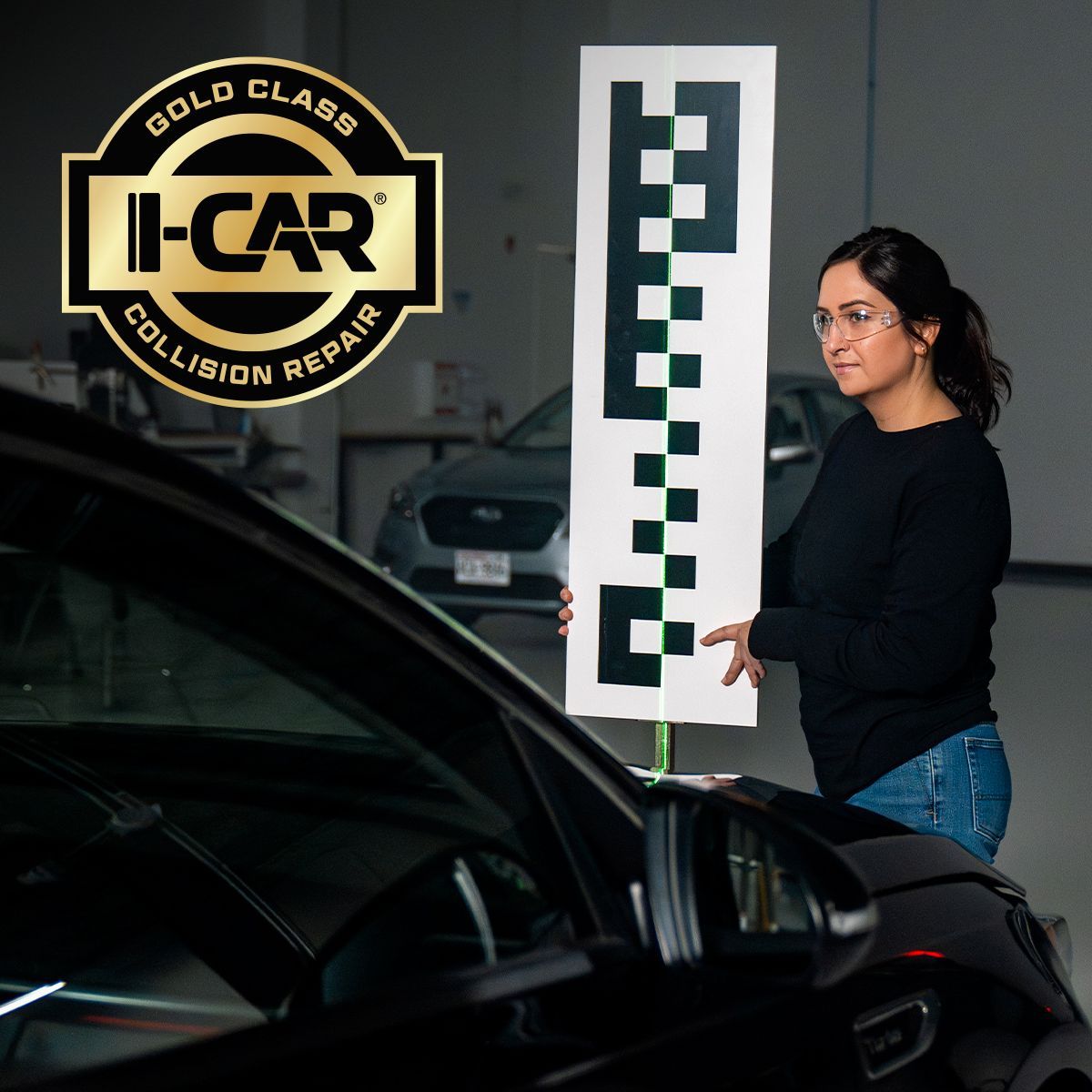
The technician parks the vehicle in a controlled environment with level flooring and proper overhead lighting. Factory-spec targets (patterns on boards or stands) are placed at precise distances and angles from the vehicle. Diagnostic software connects to the car's computer and runs the manufacturer's calibration routine, validating that the camera sees each target exactly where it should.
Static calibration requires:
- A level, unobstructed space
- The exact OEM targets for that make and model
- The manufacturer's current diagnostic software
- A trained technician
Most of the ADAS work triggered by windshield replacement is static.
Dynamic calibration
The technician takes the vehicle on a road test at specific speeds and conditions. The software uses real-world data (lane markings, surrounding vehicles, signposts) to fine-tune the system. Dynamic calibration supplements static calibration on many modern vehicles and is required on some systems (notably adaptive cruise and some lane-keep variants).
Dynamic calibration requires:
- Clear weather
- Visible lane markings
- Traffic ahead to track against
- A specific route and speed profile per OEM spec
Why some vehicles need both
A 2022 Hyundai Tucson with the full SmartSense package, for example, needs a static calibration for the windshield-mounted forward camera after glass replacement. Then a dynamic calibration run to retune the lane keep assist and adaptive cruise against road data. Skip either, and one or more safety systems will behave unpredictably.
For a detailed breakdown of the whole calibration process at Texas Auto Center, read our ADAS calibration page.
How Much Does Windshield ADAS Calibration Cost in Houston?
Here are realistic 2026 ranges for Houston:
| Scenario | Typical Cost |
|---|---|
| Single windshield camera static calibration | $150-$300 |
| Static + dynamic on a multi-system vehicle | $300-$600 |
| Luxury or EV with multiple windshield-adjacent sensors | $500-$1,000+ |
Cost depends on:
- Make and model (luxury brands often require proprietary tooling and longer routines)
- Whether static only or static + dynamic
- Whether other systems (rain sensor, auto-dim mirror, etc.) also need recalibration
If insurance is covering the underlying windshield claim, in most cases the calibration is included. Keep reading.
Does Insurance Cover ADAS Calibration After Windshield Replacement?
In most cases, yes. If your windshield claim is covered under your comprehensive auto insurance (the coverage that pays for glass damage, theft, and hail), the ADAS calibration is typically covered alongside it, minus your deductible.
Many Texas policies include full glass coverage that waives the deductible for windshield replacement, if yours does, your out-of-pocket cost on the calibration is often zero.
Where it gets tricky
Some glass shops skip the calibration line item on the initial estimate. Sometimes it's oversight. Sometimes it's a pricing tactic. Either way, the calibration is still required if your vehicle's OEM procedure calls for it.
When we catch a calibration that the initial estimate missed, we write a supplement to the claim. A supplement is an addition to the repair estimate for work that wasn't originally included. The carrier reviews the supplement (typical 2-7 business days) and approves it once they see the OEM procedure citation and the pre-scan documentation showing the systems need calibration. You don't pay the difference, the carrier does. See how our supplement process works.
Questions worth asking before you sign anything
If you're about to get a windshield replacement, ask the shop:
- "Does my vehicle require ADAS calibration after this replacement?"
- "Is calibration included in your estimate?"
- "Is it done in-house or sent out?"
- "Will you provide pre- and post-repair diagnostic scan reports?"
If the answers are vague, call us for a second opinion. The last thing you want is a windshield that looks great and safety systems that don't work.
What Happens If You Skip Calibration?
Best case: you drive around with ADAS features that work inconsistently or don't engage at all.
Worst case: the system thinks it's working, but the camera is pointed at the wrong spot, and the warnings fire late or in the wrong direction. Your lane-keep assist might drift toward the line instead of away from it. Your adaptive cruise might accelerate instead of braking in stop-and-go traffic. Your automatic emergency braking might miss an obstacle entirely or fire on a phantom one.
Here's how this plays out. Jennifer, a Gulfton driver, had her 2021 Nissan Rogue windshield replaced at a fast mobile glass service after a rock strike on I-59. The technician did a great job on the glass. The calibration? "Not needed for this model," he told her. Six weeks later, she was rear-ended at a red light. Her AEB didn't fire. After the collision she brought the car to us for repair. Our pre-repair scan showed the forward-camera module was reporting valid data but out of calibration spec. The system was functionally disabled. Her insurance paid for the post-collision calibration as part of the new repair, but the six-week gap had exposed her to preventable risk.
It's worth stating: Jennifer's follow-up glass shop was working in good faith. ADAS calibration requirements aren't always obvious to the tech on the ground. That's exactly why this matters, the assumption that "if it starts and the dash looks clean, it's fine" is dangerous on modern cars.
Other consequences of skipping calibration:
- Your vehicle manufacturer's warranty may be affected if the car is later diagnosed with uncalibrated safety systems
- Insurance companies sometimes look for prior improper repairs when investigating new claims. A skipped calibration during a covered glass claim can complicate a future accident claim.
- Resale value, an uncalibrated ADAS system is a flag during pre-purchase inspections on late-model vehicles
How We Do It at Texas Auto Center
Every qualifying windshield replacement at TAC includes the full calibration workflow as a standard step, not an optional upsell.
1. Pre-work diagnostic scan. We connect to your vehicle's OBD-II port and capture stored fault codes and ADAS system status before any work begins. This gives us a before-state baseline that we include in the repair documentation.
2. Windshield replacement to OEM procedure. We use OEM or OEM-equivalent glass (depending on what the manufacturer's procedure specifies for your vehicle) and the adhesives and cure times the OEM requires. Calibration can't succeed if the glass isn't installed to spec.
3. Static calibration. With the new glass cured, we set up the factory-spec targets in our calibration bay, connect the OEM calibration software, and run the routine. Target distances are measured precisely, lighting is controlled, and the software validates that every relevant sensor sees the target where it should.
4. Dynamic calibration (when required). For vehicles that need a road-test component, we run the manufacturer's prescribed route at the prescribed speeds. Typical duration: 15-30 minutes.
5. Post-work diagnostic scan. Full system scan confirms every module reports healthy, no new fault codes, calibration statuses verified.
6. Documentation. Pre- and post-repair scan reports, calibration completion records, and procedure citations are all saved to your repair file. If insurance is covering the work, the documentation goes to your carrier alongside the invoice.
Most windshield ADAS calibrations take 1-3 hours on top of the glass replacement time.
OEM-Certified Calibration
Texas Auto Center is factory-certified for:
For these brands, we follow the manufacturer's published calibration procedure exactly, using the tooling and targets the OEM requires. For other brands, we still follow the OEM procedure, use I-CAR-trained technicians, and document every step the same way.
Frequently Asked Questions
My car is a 2017 model. Do I still need ADAS calibration after windshield replacement?
Possibly. ADAS features started showing up in the mid-2010s on premium trims and spread to most trims by 2018-2019. Check your vehicle's owner's manual under "Driver Assistance" or call us with your year, make, model, and trim.
What if the glass shop already replaced my windshield without calibrating?
Bring the car in for a diagnostic check. We can run a pre-scan to see whether your ADAS systems are still in spec or whether they need calibration after the fact. If calibration is needed, we can usually get it done the same day.
Will my insurance cover a calibration I pay for out of pocket after the fact?
Sometimes, depending on your carrier and policy. If the original glass claim is still open, we may be able to write a supplement back to the original claim. If the claim is closed, it's harder, but some carriers will reopen for legitimate repair-required items. Call us and we'll help you navigate it.
Do mobile glass shops do ADAS calibration?
Some do. Many don't. The ones that do usually perform dynamic calibration (road test) only, which doesn't cover all static-calibration requirements. If your vehicle requires static calibration with factory targets, a mobile glass shop typically can't complete it, they need to send the car to a shop with the proper bay setup.
How long after windshield replacement do I have to get calibration done?
As soon as possible. Driving an uncalibrated vehicle with ADAS engaged is risky. If you must drive briefly (home from the shop, for example), keep ADAS features turned off where possible.
Can I just reset my ADAS to fix the calibration?
No. Calibration is a physical and software process that requires specific equipment. A "reset" in the car's menu doesn't re-aim cameras or retarget radar. Only a proper calibration procedure works.
Does Texas Auto Center work with my insurance for this?
Yes. We work with every major carrier in Texas, Geico, State Farm, Progressive, Allstate, USAA, and the rest, and handle the claim paperwork directly. You pay your deductible (if any). The carrier pays us.
Is calibration required after hail damage that broke my windshield?
Yes, if the windshield was replaced. A hail strike that cracks a windshield-mounted camera or its housing may also require calibration even if the glass itself is salvageable. Read our hail damage repair page for more on the intersection of hail, glass, and ADAS.
Get Your Free ADAS Calibration Estimate
If your windshield was just replaced, or is about to be, we can tell you whether your vehicle requires calibration, whether insurance will cover it, and what the realistic cost is.
Call (713) 667-1100 or request a free estimate online. Or drop by 5609 Bellaire Blvd #B during business hours.
Serving Southwest Houston since 2011. I-CAR, ASE, and RepairPal certified. Factory-certified for Nissan, Infiniti, Kia, Hyundai, Genesis, and FCA/Mopar. Lifetime paint warranty. We work with every major insurance carrier.
Your safety systems aren't optional. Let's make sure they actually work.